Concrete Lifting Service
Void filling and soil stabilization in Utah County
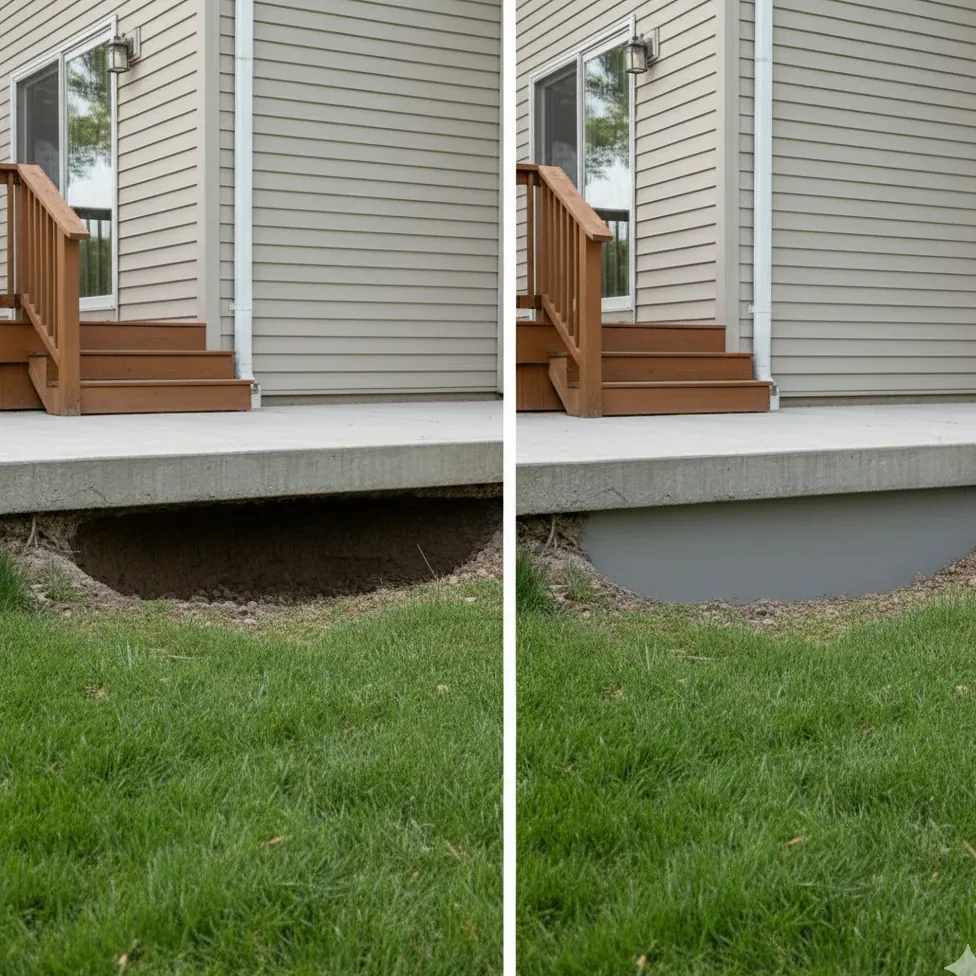
Sometimes concrete sinking happens not because of a bad slab, but because of what's underneath. Voids—empty spaces beneath your concrete—develop when soil erodes due to water movement, poor compaction, or natural washout. When a void opens under a slab, there's nothing supporting that section. The concrete drops, cracks, and becomes unstable. Simply lifting the slab without filling the void is a temporary fix; the slab will sink again once the foam settles.
Void filling is the foundation-level repair that prevents repeat settlement. By injecting stabilizing foam deep beneath your slab and filling all voids, we eliminate the root cause of the problem. This is especially critical for driveways, patios, and garage floors that have already failed once, or for areas experiencing repeated moisture and subsurface movement issues common throughout Utah Valley.
Understanding Voids: Why Concrete Keeps Sinking
Voids form when:
- Water erosion: Groundwater flows beneath the slab, washing away soil and leaving hollow spaces
- Poor compaction: Original fill soil wasn't properly compacted, so it settles and consolidates over time
- Freeze-thaw damage: Utah's winter freeze-thaw cycles expand and contract soil, creating gaps
- Tree roots: Growing roots absorb moisture and create voids, or decay after the tree is removed
- Age and wear: After 15-20 years, original fill soil can consolidate significantly beneath old slabs
If your slab settles again after previous repairs, or if you tap it and hear a hollow sound, voids are almost certainly present. Simply lifting the slab again without addressing the voids will result in the same problem recurring within months or years.
Utah County Soil & Moisture Issues
Utah Valley's unique geology makes void formation and soil instability common problems. Our soils are clay-rich and prone to moisture retention. Seasonal snowmelt adds significant water. Poor natural drainage in many areas means water collects and saturates the soil beneath your slabs.
Additionally, many properties were built on less-than-ideal fill material. Builders sometimes used substandard compaction practices, inadequate fill depth, or inappropriate soil types. These shortcuts lead to problems decades later.
Void filling with expanding polyurethane foam solves this. The foam stabilizes loose soil, fills voids completely, and hardens to create solid, permanent support. It also resists moisture degradation, making it ideal for Utah's wet conditions. Unlike concrete mudjacking (the old method), polyurethane foam doesn't compact over time and doesn't get weaker with water exposure.
The Void Filling & Stabilization Process
Our two-part polyurethane foam is injected beneath your concrete through small access holes we drill in the slab. The foam expands rapidly, filling voids completely and lifting the surface back to level. Sensors tell us exactly when the slab reaches the right height. Once the foam hardens, your concrete is supported on a solid, stable foundation. The result is permanent. Unlike mudjacking, polyurethane foam actually bonds to your concrete and resists the moisture that causes soil failure in the first place.
Most void filling jobs are completed in a single day, and you can use the surface immediately. The access holes are small and easily sealed.
We combine void filling with driveway lifting, garage floor leveling, patio repair, and sidewalk leveling as needed. If you have sinking concrete throughout your property, we address it all with a comprehensive plan. We serve Provo, Orem, Lehi, American Fork, Spanish Fork, Springville, Pleasant Grove, Saratoga Springs, and all of Utah County. Call (385) 219-4385 for a free estimate.